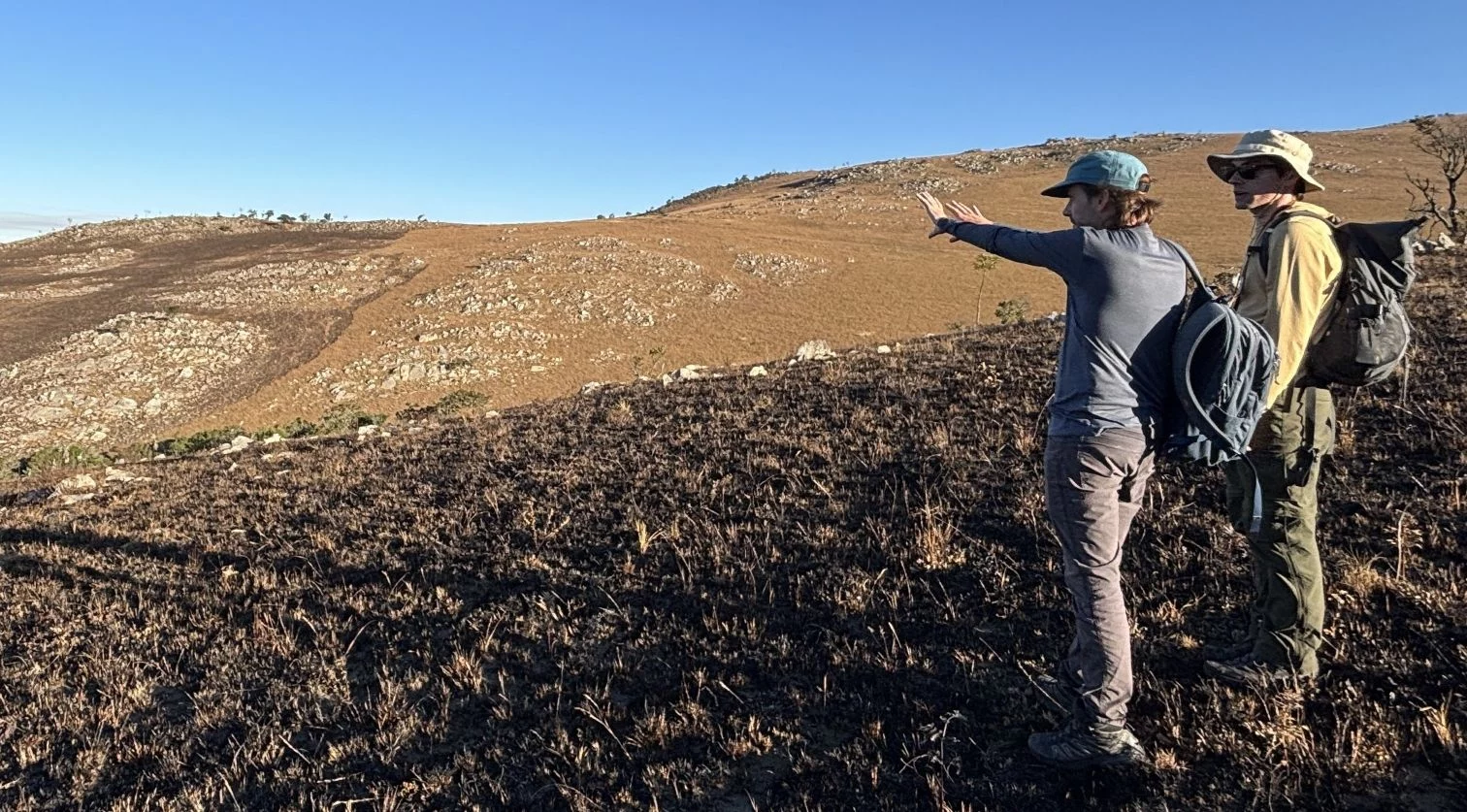
FEATURE IMAGE: US-American geologists discuss the deformation of rock strata near Shiyalongubo Road. Photo by L Webb
From June to August, at least four research groups have made Barberton their base for field work: a US-group from Stanford University in California, led by Prof Mathieu Lapotre; a Norwegian group led by Prof Desiree Roerdink from University of Bergen; a Norwegian team with Prof Paul Mason from Utrecht University; and a German group from Jena University, led by Prof Christoph Heubeck.
ALSO READ: Popular Night of a Thousand Stars returns in style – myLowveld.net

They all share a research interest in the surface conditions of the early Earth – a time when Earth was essentially a different planet without oxygen in the air, no vegetation nor animals, abundant volcanism, peppered by meteorite impacts, and even lacking continents.
However, microbial mats already grew along the shorelines, and plankton floated in the oceans and around submarine hot springs. Famously, the Barberton mountains are the pre-eminent place in the world where sedimentary rock strata (which had been deposited at the surface) escaped the eternal “recycling” of rock by deformation, heating and remelting.
Their layers can still be followed for many kilometres in the field, even though they are heavily folded and deformed, turned vertical and upside-down.
ALSO READ: Dancing Queens hand over R115 000 to Feed The Need White River

“Our studies of these rocks is almost never-ending, because the questions we ask the rocks change with time,” says geologist Christoph Heubeck.
“Where a hundred years ago the search for gold and minerals were in the minds of the exploring geologists, we now look for an entirely different class of information: indicators of the surface temperature, the chemistry of the ocean water, the composition of the atmosphere, and the conditions experienced by the earliest microbial life forms. It is a bit like holding a book – we are no longer interested in the paper and ink, but in the story written down there.”
Prof Lapotre’s group, for example, is interested in evidence of windblown sediment in the strata of the Moodies Group, because these may hold clues to the climate pattern on early Earth.
“Fossilised sand dunes may tell us just how thick the atmosphere was when life first arose on Earth,” says Prof Lapotre. “We are hunting for them around Barberton.”
Overlapping with this group, the group around Profs Roerdink and Mason have studied the world’s oldest baryte and gypsum deposits near the Eswatini border and in the western Barberton Makhonjwa Mountains.
“Both minerals contain sulfur, and that element is almost as widely moved through air, water and rocks as gas, dissolved in water, or in minerals as carbon does,” says Prof Mason who specialises in geochemistry of sulfur. “By studying their isotopic composition, we can learn a lot about how little oxygen there was in the atmosphere and how microorganisms were growing and breathing with sulfur compounds at the time when the rocks were formed.
Prof Roerdink adds: “The ancient rocks around Barberton are an extraordinary window into Earth’s past. They help us understand how the first forms of life evolved and how they changed our planet over billions of years.”

Prof Heubeck, a sedimentologist, focused his interest this year on the composition of ancient gravels. He has observed that their composition changes much more quickly with transport distance than we see today.
“My hypothesis is that rain and river water were far more acidic from all the volcanism than today, and that it was also overall hotter. So some gravel dissolved within a few kilometers of transport or rapidly disintegrated into sand,” Heubeck says. Along with his field assistants, he has counted the clast composition from more than 160 outcrops to examine his hypothesis.
MSc student Armin Waldmann is here with Prof Heubeck for his second time, having previously completed a BSc degree on a mountain near the border to Eswatini.
“I particularly like how our work is embedded in the society,” he says. “We do not just ‘parachute in and helicopter out’, but interact with foresters, government agencies, landowners and tourists. We even encounter zama-zamas. We report our findings in talks to the local population, exchange data and rocks with the gold mines around Barberton, and contribute to the Barberton museum.”
Christoph Chiburre, a local geologist, acts as field assistant to Heubeck’s group. He contributes to the recording of statistical data and to rock sampling.
“This is an invaluable learning experience for me,” he says. “Here, I am being trained in advanced geological techniques that cannot be taught in the classroom. This helps me to understand the meaning of the rock strata better and to communicate more effectively with local learners.”
Roerdink, Mason, Lapotre and Heubeck, the experienced leaders of the four international groups, agree on the immense value of the rock strata in the Barberton Makhonjwa Mountains.
“The rocks are better preserved than anywhere else in the world and still harbour much information – you just need to ask them the right questions,” says Heubeck. “When reading scientific literature from the 1960s or 1970s, we are occasionally astonished at what was not known back then and how much knowledge we have added since, mostly through persistent and detailed documentation and through our much better analytical instruments.
“The challenge now is to make our maps and data more easily accessible to one another so that we do not duplicate or repeat each other’s work. Also, we all need to become better at transferring our insights to the public. We now have a fair understanding of how the world looked back then and how life accommodated itself on a very strange planet.”
To that end, the scientists are working on interactive geological maps, texts and illustrations.
All of the foreigners feel comfortable in Barberton and plan to return. The scientists say the people of the area wave as they drive by and chat with them when they are shopping – something that does not happen to them back home.
Astrid Christianson, head of the Barberton Community Tourism office, agrees.
“We try to make the international geologists feel at home in Barberton and in our mountains,” she says. “They have contributed much to make Barberton’s World Heritage Site and the R40 Geotrail across the mountains a reality. They also conducted a research drilling programme in 2021/2022 that drew national and international attention. This benefits the local economy and regional education.”